Sheep (Dolly)
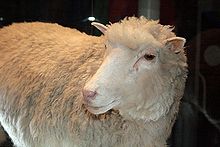
About Dolly
Dolly was born on 5 July 1996 and had three mothers (one provided the egg, another the DNA and a third carried the cloned embryo to term).[6] Named after the world'smost common sheep name, in which 87% of sheep are named, "Dolly." She was created using the technique of somatic cell nuclear transfer, where the cell nucleus from an adult cell is transferred into an unfertilized oocyte (developing egg cell) that has had its cell nucleus removed. The hybrid cell is then stimulated to divide by an electric shock, and when it develops into a blastocyst it is implanted in a surrogate mother.[7] Dolly was the first clone produced from a cell taken from an adult mammal.[8][9] The production of Dolly showed that genes in the nucleus of such a mature differentiatedsomatic cell are still capable of reverting to an embryonic totipotent state, creating a cell that can then go on to develop into any part of an animal.[10]Dolly's existence was announced to the public on 22 February 1997.[1] It gained much attention in the media. A commercial with Scottish scientists playing with sheep was aired on TV, and a special report in TIME Magazine featured Dolly the sheep.[2] Science featured Dolly as the breakthrough of the year. Even though Dolly was not the first animal cloned, she received media attention because she was the first cloned from an adult cell.[11]
Genesis
Dolly was cloned by Ian Wilmut, Keith Campbell and colleagues at the Roslin Institute, part of the University of Edinburgh, Scotland, and the biotechnology company PPL Therapeutics, based near Edinburgh. The funding for Dolly's cloning was provided by PPL Therapeutics and the UK's Ministry of Agriculture.[2] She was born on 5 July 1996 and died from a progressive lung disease five months before her seventh birthday.[3] She has been called "the world's most famous sheep" by sources including BBC News and Scientific American.[4][5]
The cell used as the donor for the cloning of Dolly was taken from a mammary gland, and the production of a healthy clone therefore proved that a cell taken from a specific part of the body could recreate a whole individual. On Dolly's name, Wilmut stated "Dolly is derived from a mammary gland cell and we couldn't think of a more impressive pair of glands than Dolly Parton's".[1]
Life
Dolly lived her entire life at the Roslin Institute in Edinburgh.[12] There she was bred with a Welsh Mountain ram and produced six lambs in total. Her first lamb, named Bonnie, was born in April 1998.[3]The next year Dolly produced twin lambs Sally and Rosie, and she gave birth to triplets Lucy, Darcy and Cotton in the year after that.[13] In late 2001, at the age of four, Dolly developed arthritis and began to walk stiffly. This was treated with anti-inflammatory drugs.[14]
Death
On 14 February 2003, Dolly was euthanised because she had a progressive lung disease and severe arthritis.[15] A Finn Dorset such as Dolly has a life expectancy of around 11 to 12 years, but Dolly lived 6.5 years. A post-mortem examination showed she had a form of lung cancer called ovine pulmonary adenocarcinoma, also known as Jaagsiekte,[16] which is a fairly common disease of sheep and is caused by the retrovirus JSRV.[17] Roslin scientists stated that they did not think there was a connection with Dolly being a clone, and that other sheep in the same flock had died of the same disease.[15] Such lung diseases are a particular danger for sheep kept indoors, and Dolly had to sleep inside for security reasons.
Some in the press speculated that a contributing factor to Dolly's death was that she could have been born with a genetic age of six years, the same age as the sheep from which she was cloned.[18] One basis for this idea was the finding that Dolly's telomeres were short, which is typically a result of the agingprocess.[19][20] The Roslin Institute stated that intensive health screening did not reveal any abnormalities in Dolly that could have come from advanced aging.[18]
In 2016 scientists reported no defects in thirteen cloned sheep, including four from the same cell line as Dolly. The first study to review the long-term health outcomes of cloning, the authors found no evidence of late-onset, non-communicable diseases other than some minor examples of osteoarthritis and concluded "We could find no evidence, therefore, of a detrimental long-term effect of cloning by SCNT on the health of aged offspring among our cohort."[21][22]
- "1997: Dolly the sheep is cloned". BBC News. 22 February 1997.
- ^ Jump up to:a b Edwards, J. (1999). "Why dolly matters: Kinship, culture and cloning". Ethnos. 64 (3–4): 301–324. doi:10.1080/00141844.1999.9981606.
- ^ Jump up to:a b "Dolly the sheep clone dies young". BBC News. 14 February 2003
- Jump up^ "Is Dolly old before her time?". BBC News. London. 27 May 1999. Retrieved 4 October 2009.
- Jump up^ Lehrman, Sally (July 2008). "No More Cloning Around". Scientific American. Retrieved 21 September 2008.
- Jump up^ Williams, N. (2003). "Death of Dolly marks cloning milestone". Current Biology. 13 (6): 209–210. PMID 12646139. doi:10.1016/S0960-9822(03)00148-9.
- Jump up^ Campbell KH; McWhir J; Ritchie WA; Wilmut I (1996). "Sheep cloned by nuclear transfer from a cultured cell line". Nature. 380 (6569): 64–6. Bibcode:1996Natur.380...64C. PMID 8598906. doi:10.1038/380064a0.
- Jump up^ McLaren A (2000). "Cloning: pathways to a pluripotent future". Science. 288 (5472): 1775–80. PMID 10877698. doi:10.1126/science.288.5472.1775.
- Jump up^ Wilmut I; Schnieke AE; McWhir J; Kind AJ; et al. (1997). "Viable offspring derived from fetal and adult mammalian cells". Nature. 385 (6619): 810–3. Bibcode:1997Natur.385..810W. PMID 9039911. doi:10.1038/385810a0.
